Liberia Launches Gender-Based Violence Information Management System to Strengthen Survivor Protection
Author: Claudius T. Greene, Jr 丨Source : Daily Observer Newspaper
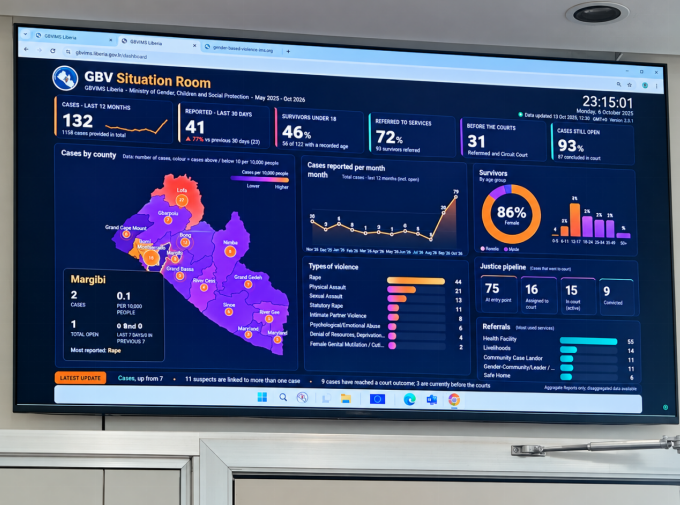
MONROVIA, Liberia — The Government of Liberia, in partnership with the United Nations Population Fund (UNFPA), the European Union (EU), and other development partners, has officially launched an upgraded Gender-Based Violence Information Management System (GBVIMS) aimed at improving the collection, management, and use of data to strengthen services for survivors of gender-based violence (GBV).
The system is expected to improve coordination among healthcare providers, social workers, legal practitioners, security institutions, and other service providers by establishing a standardized approach to documenting GBV incidents and supporting survivor-centered interventions across Liberia.
Speaking at the launch, UNFPA Country Representative Dr. Mady Baiye described the system as a milestone in efforts to protect human dignity and strengthen accountability for women and girls.
He said the initiative goes beyond the introduction of a database, describing it as a vital tool for improving service delivery, identifying gaps in the response to GBV, and ensuring that survivors receive timely and appropriate assistance.
“Today, we are not just deploying a database; we are launching a vital tool for end-to-end accountability for women and girls across Liberia,” Dr. Baiye said.
According to him, gender-based violence remains a pervasive human rights violation in Liberia, with an average of four women and girls reportedly raped daily, three of whom are adolescents.
Dr. Baiye also highlighted challenges in accessing timely medical care following rape, noting that only 47 percent of women and girls raped over the past five years reportedly sought assistance within 72 hours, while 31 percent of those raped received post-exposure prophylaxis (PEP) within the same period.
He said the figures demonstrate the urgent need to strengthen referral systems, improve access to healthcare, and ensure that survivors receive the support they need without unnecessary delays.
Dr. Baiye emphasized that behind every GBV statistic is a survivor seeking safety, medical attention, psychosocial support, and justice.
He said the absence of safe, standardized, and reliable information management systems has historically limited the ability of institutions to identify service gaps, direct resources effectively, develop evidence-based prevention strategies, and assess the impact of interventions.
The upgraded GBVIMS is designed to address these challenges through standardized incident reporting, survivor-centered services, secure data management, and evidence-based decision-making.
Dr. Baiye explained that when service providers use a common system for recording and managing information, referrals can become more coordinated, response times can improve, and weaknesses in service delivery can be identified and addressed.
He stressed, however, that the system must be supported by concrete action to produce meaningful results.
“Data alone does not end gender-based violence—action does. But with the GBV-IMS, our actions will be smarter, faster, more targeted, and significantly more impactful,” he said.
UN Calls for Coordinated Response
United Nations Resident Coordinator in Liberia Christine Umutoni described the launch as a landmark achievement in the country's efforts to prevent and respond to gender-based violence.
She said the system would facilitate coordination among institutions responsible for providing services to survivors while helping the government and its partners better understand patterns of violence and measure the effectiveness of their interventions.
Umutoni noted that fragmented reporting and the absence of unified information have made it difficult to establish a comprehensive understanding of GBV and ensure accountability across the response system.
“When we lack unified and standardized data, when we cannot track the patterns of violence, and when we cannot measure the impact of our interventions, we operate in the dark,” she said.
According to her, the GBVIMS will support prevention, detection, and response by providing a standardized framework for collecting and aggregating information while protecting survivors' confidentiality and dignity.
On prevention, Umutoni said the system would help institutions identify trends and direct community awareness campaigns, resources, and other interventions toward areas where they are most needed.
She explained that reliable information would also help identify emerging forms of violence and populations facing heightened risks.
Regarding response, the UN Resident Coordinator said the system would strengthen coordination among healthcare providers, psychosocial support services, legal institutions, and security agencies to improve the continuity of care for survivors.
She called on law enforcement officers, healthcare workers, social workers, judicial officials, and civil society organizations to uphold the highest standards of data integrity, confidentiality, and survivor care.
Umutoni also commended the Ministry of Gender, Children and Social Protection for its leadership, UNFPA for providing technical support, and the European Union for its contribution through the Spotlight Initiative 2.0.
She said the system's success would ultimately depend on the commitment of institutions and service providers to use the information responsibly and translate it into practical interventions.
Gender Ministry Welcomes System
Gender, Children and Social Protection Minister Gbeme Horace-Kollie welcomed the launch, describing the system as a historic achievement for Liberia's efforts to address gender-based violence.
She expressed appreciation to UNFPA, the European Union, other UN agencies, civil society organizations, and national institutions for their support in making the initiative possible.
The minister also commended the joint technical team, consultants, and officials who worked to develop and finalize the system.
Horace-Kollie said the government was grateful for the partnership and expressed confidence that the new platform would be used effectively to strengthen the country's GBV response.
She disclosed that data collectors and other personnel associated with the system had received training before the official launch, with refresher training expected to continue to strengthen their capacity.
The minister said the initiative represented a shared commitment to improving coordination among institutions and ensuring that the system delivers practical benefits to survivors and communities.
She emphasized the importance of sustained collaboration between the government and its partners in addressing the challenges associated with gender-based violence.
UNFPA Hands Over ICT Equipment
As part of the launch, Dr. Baiye officially handed over assorted Information and Communications Technology (ICT) equipment to the Ministry of Gender, Children and Social Protection to support the operation of the GBVIMS.
The donation comprises four laptop computers, one data server and its accessories, 40 tablets, 60 solar power banks, networking devices and accessories, as well as the installation of high-speed internet with a one-year subscription.
According to Dr. Baiye, the equipment is intended to strengthen the ministry's technical and operational capacity to collect GBV data, manage cases, and coordinate responses in a timely manner.
He said reliable digital infrastructure and efficient information management were essential for effective governance, policy development, and service delivery, particularly in protecting women, adolescent girls, and other vulnerable populations.
Dr. Baiye noted that the equipment would support efforts to capture timely information, improve coordination mechanisms, and extend services to communities across Liberia's 15 counties.
He urged the ministry to ensure that the donated assets were used strategically to improve institutional performance, protect sensitive information, and strengthen the delivery of social protection services.
The UNFPA representative reaffirmed the agency's commitment to supporting the government and civil society in reducing gender-based violence and harmful practices against women and girls.
He also commended the European Union for its strategic partnership through the Spotlight Initiative, which supported UNFPA's technical assistance in developing the information management system.
Dr. Baiye extended appreciation to the ministry, national institutions, civil society organizations, frontline service providers, and the technical team for their contributions to the initiative.
Focus on Accountability and Survivor Protection
The launch of the upgraded GBVIMS marks an effort to strengthen the institutional response to gender-based violence by improving how information is collected, managed, and used to guide interventions.
The system's effectiveness will depend on its consistent use by relevant institutions, adequate technical capacity, responsible information sharing, and strict safeguards for survivors' privacy.
For survivors, improved coordination could help reduce gaps in referrals and access to essential services, including medical care, psychosocial support, legal assistance, and protection.
The initiative also places renewed emphasis on the need to move beyond recording incidents toward using reliable information to inform prevention, improve services, and strengthen institutional accountability.
UNFPA reaffirmed its commitment to working with the Liberian government and civil society to strengthen technical capacity, data protection governance, and survivor-centered services across the country.
The launch concluded with a call for government institutions, development partners, and service providers to work collectively toward a Liberia where women, girls, and other vulnerable people can live free from violence and access the safety, dignity, and justice they deserve.